Self-Love, Brotherhood, and the Inner Work of Fatherhood: A Father’s Day Roundtable
What does it actually take to be a great dad?
Most men immediately think about their kids.
Being more present. More patient. More involved.
But what if the hardest part of fatherhood has nothing to do with your children?
What if it has everything to do with the relationship you have with yourself?
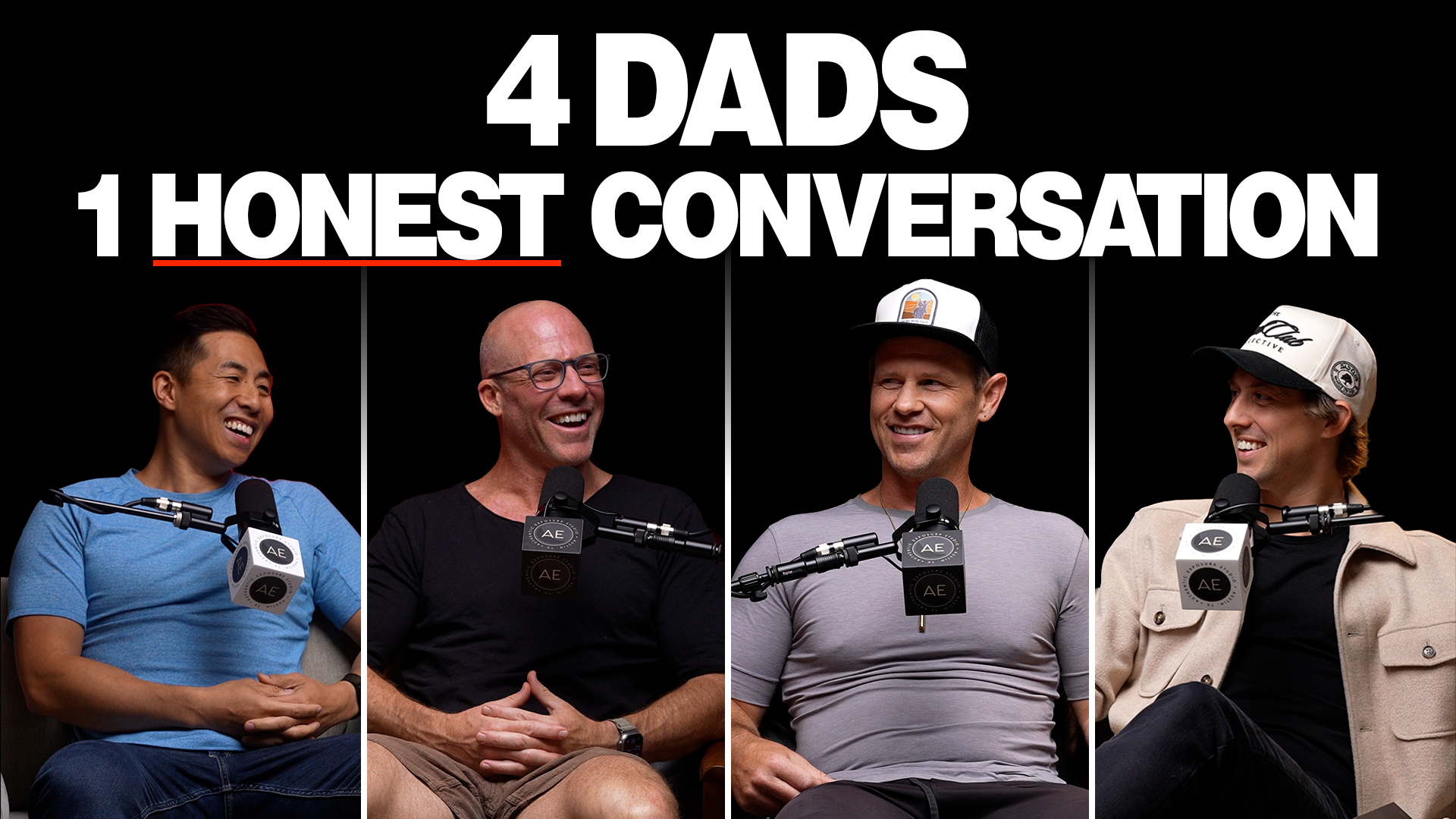
In this special Father’s Day roundtable, Jon Vroman sits down with Front Row Dads members Mike Chu, Scott Seymour, and Austin Distel for one of the most honest conversations we’ve had about what fatherhood really brings up. This isn’t a tactical conversation about parenting strategies or family systems. It’s four men exploring grief, self-worth, healing, brotherhood, and the inner work that quietly shapes how we show up for the people we love.
What emerges is a powerful realisation: how you treat yourself is often the foundation for how you treat everyone else.
Why Father’s Day Is More Complicated Than We Admit
For many men, Father’s Day isn’t simply a celebration.
It’s a reflection point.
It brings up memories of our fathers, the relationship we had with them, the relationship we wish we’d had, and the relationship we’re now creating with our own children.
Throughout the conversation, each man shares a different perspective. Mike reflects on losing his father. Scott opens up about grief, abandonment, and healing. Austin talks about preparing to become a father for the first time. Jon shares why holidays have often felt emotionally complicated throughout different seasons of his life.
What makes the discussion so relatable is that nobody pretends fatherhood is simple. The conversation creates space for the complexity that many men carry but rarely discuss openly.
Self-Love Is Not Soft
One of the strongest themes throughout the roundtable is the idea that self-love is often misunderstood.
Many men hear the phrase and immediately associate it with weakness, comfort, or self-indulgence. The guys around the table challenge that assumption directly.
Mike shares his journey from self-hatred to self-respect and explains how years of self-punishment affected every area of his life. Growing up in an environment built around performance and discipline, he learned to motivate himself through criticism rather than compassion. For years, he believed that being hard on himself was the only path to growth.
Eventually he discovered something surprising.
“The more I lowered my shield, the sharper my sword got.”
Rather than making him weaker, self-acceptance made him stronger. It helped him become a better father, a better husband, and a better leader because he was no longer spending so much energy fighting himself.
The conversation repeatedly returns to the same insight: self-love isn’t the absence of accountability. It’s the foundation that makes accountability sustainable.
All Parts Are Welcome
Perhaps the most powerful idea from the entire roundtable comes from Mike’s reflection on what he hopes his children know about themselves.
Not that they’re successful.
Not that they’re perfect.
Not that they’re impressive.
Simply this:
“All parts of you are welcome.”
Mike describes spending years trying to punish, suppress, or eliminate the parts of himself he didn’t like. The scared parts. The insecure parts. The angry parts. The parts that wanted to hide. The parts that didn’t measure up.
Eventually he realized that healing wasn’t about winning a war against those parts.
It was about learning to welcome them.
The idea becomes one of the emotional anchors of the conversation because it applies equally to fatherhood. Children thrive when they know they are loved completely, not conditionally. The same is often true for adults.
Restorative Beats Punitive
One of the most memorable moments comes when Jon shares a story about Azeem, a father whose teenage son was murdered.
What happened afterward challenged Jon’s entire understanding of punishment, restoration, and forgiveness.
The conversation evolves into a broader question:
How do we treat people when they make mistakes?
And perhaps more importantly:
How do we treat ourselves?
The group explores the difference between punitive energy and restorative energy. Punishment focuses on condemnation. Restoration focuses on healing, growth, and reintegration.
At one point, Jon realizes that while he often tries to offer grace to others, he isn’t always willing to extend the same grace to himself.
That insight lands hard because many fathers operate under a similar standard: compassion for everyone except themselves.
Kids Do What They See
Another major theme throughout the conversation is modeling.
Scott shares a story about meeting a young father who believed his primary responsibility was providing financially for his family. While nobody around the table dismisses the importance of provision, Scott offers a deeper challenge.
If children learn primarily through observation, what happens when the only thing they see is sacrifice, stress, and constant work?
What happens when fathers model productivity but not self-care?
Achievement but not joy?
Responsibility but not play?
The discussion becomes a reminder that taking care of yourself isn’t separate from parenting. In many ways, it is parenting. The relationship your children observe you having with yourself often becomes the blueprint they use to build their own.
Why Brotherhood Matters
The final theme woven throughout the conversation is brotherhood.
Mike openly admits that for years he identified as a lone wolf. He participated in Front Row Dads while intentionally keeping his distance from deeper connection. Eventually, after attending an event and experiencing genuine community, his perspective shifted.
Scott offers a simple reframe:
When a lone wolf needs to recharge, where does he go?
Back to the pack.
The conversation highlights something many men discover later in life: strength and isolation are not the same thing. Brotherhood isn’t about dependency. It’s about having people who can tell you the truth, hold space for your growth, and remind you who you are when you’ve forgotten.
For fathers especially, that kind of community can be transformational.
What This Conversation Is Really About
At its core, this Father’s Day roundtable isn’t about parenting tactics.
It’s about the inner relationship that shapes every other relationship in your life.
It’s about learning to treat yourself with the same compassion you offer your children.
It’s about understanding that strength and softness are not opposites.
And it’s about realizing that becoming a great father often begins with becoming a better friend to yourself.
Because the relationship your kids witness most closely isn’t the one you have with them.
It’s the one you have with yourself.
Resources & Links
📚 Read what high-performing dads are reading
https://frontrowdads.com/books