
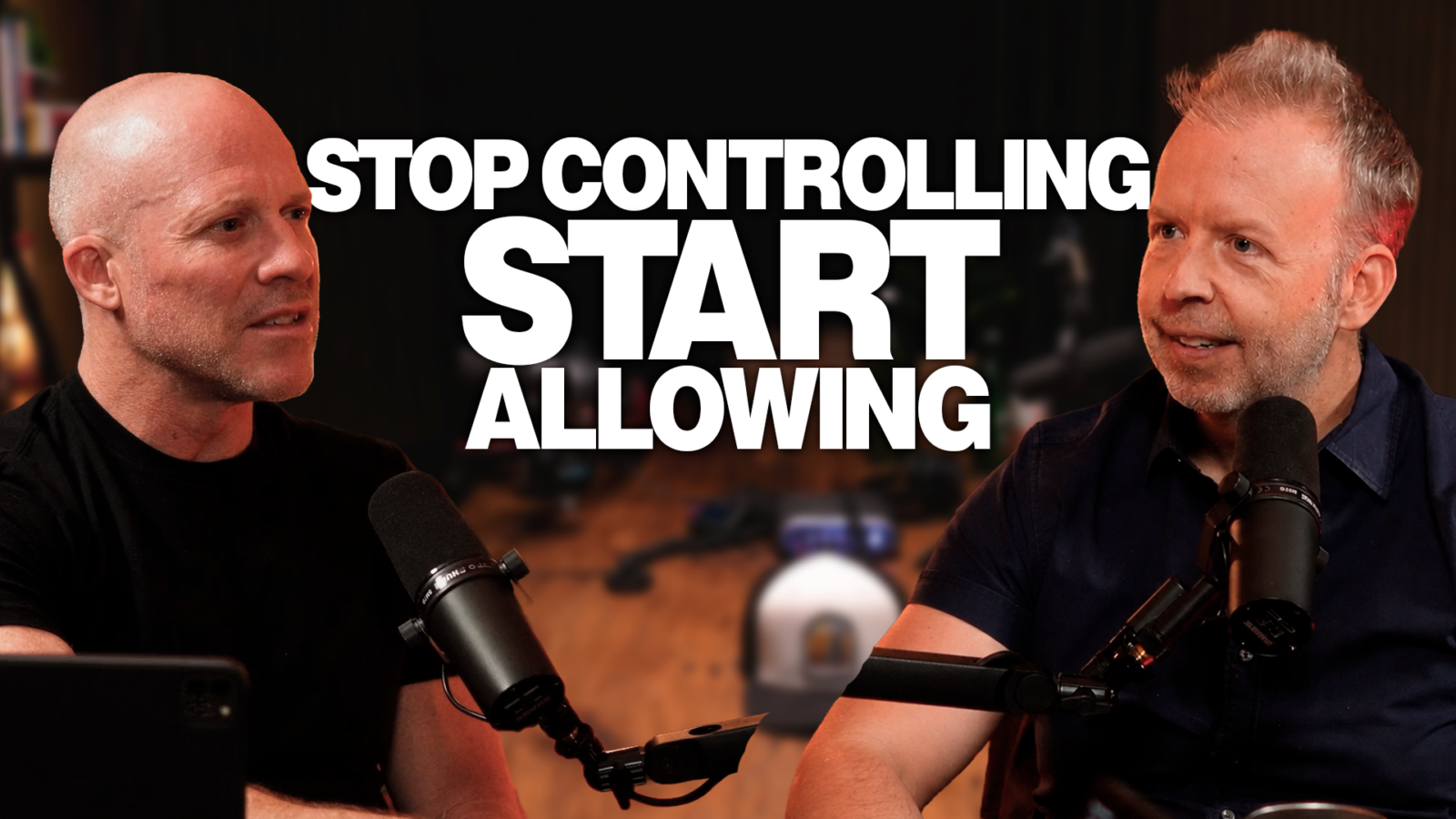
 Ep. 548
How Emotional Triggers Reveal the Patterns You Haven’t Healed (w/ Kyle Cease)
motional triggers in relationships are rarely about the moment itself.
More often, they reveal unresolved patterns, old wounds, and the parts of ourselves still searching for validation, safety, or control.
In this deeply personal and surprisingly raw conversation, Jon sits down with New York Times bestselling author, speaker, and transformational coach Kyle Cease for what becomes far more than a podcast interview.
What starts as a conversation about Kyle’s work slowly turns into a real-time exploration of emotional healing, codependency, self-worth, marriage, achievement, and the hidden patterns high performers carry for years without realizing it.
This is not a polished interview.
It’s two men letting the conversation go exactly where it needs to go.
The Patterns We Keep Repeating
One of the biggest ideas throughout the episode is that our triggers are often mirrors.
The things that activate us emotionally are rarely random. They usually point toward something unresolved inside us — a fear, a wound, a belief, or a story we’ve carried for years.
Kyle explains that many of us unconsciously hand other people responsibility for our peace.
We need our wife to understand us.
We need an apology to heal.
We need success to feel worthy.
We need certainty to feel safe.
And when those things don’t happen, we react.
Not because life is wrong… but because something old inside us is being touched.
At one point Kyle says: “The weakness I have sometimes is wanting to be understood.”
And that opens the door to a much deeper conversation about codependency, emotional responsibility, and the exhausting habit of outsourcing our emotional stability to other people.
One line especially stands out: “Your work is not to excuse her. Your work is to stop handing her the keys to your nervous system.”
Achievement, Ego, and the Fear of Not Being Enough
The episode also explores something many high performers quietly carry underneath their ambition:
The fear that who they are is still not enough.
Kyle talks about how deeply most people were conditioned as children to believe they are loved for what they do rather than for who they are.
Get the grades.
Build the business.
Achieve the goal.
Become successful.
Then maybe you’ll finally feel worthy.
But eventually that strategy starts breaking down.
Because no level of achievement can permanently solve an emotional wound.
Kyle shares a perspective that visibly lands with Jon during the conversation: “You are not loved because of what you do. You are loved because you exist.”
And suddenly the conversation becomes less about productivity and more about identity.
Less about optimization.
More about healing.
What Happens When You Stop Fighting Reality
Another major theme throughout the episode is the tension between control and surrender.
Kyle challenges the idea that every painful experience is something to immediately fix, avoid, or escape.
Sometimes relationships end.
Sometimes businesses fail.
Sometimes life completely rearranges itself.
And according to Kyle, much of our suffering comes not from what’s happening… but from our war against what’s happening.
At one point he says: “Life is doing its thing. And our problem is our war with what it’s doing.”
That doesn’t mean pretending pain doesn’t exist.
It means learning how to be present for reality instead of constantly resisting it.
The conversation touches on divorce, fear, emotional collapse, uncertainty, forgiveness, and the strange freedom that can appear when we stop trying to force life back into the shape our ego wants.
Healing Without Waiting for Someone Else to Change
One of the most powerful sections of the conversation revolves around forgiveness and emotional healing.
Kyle pushes back on the idea that healing depends on another person finally apologizing, understanding us, or changing their behavior.
Because what happens if they never do?
What happens if they stay stuck in their own patterns forever?
According to Kyle, true healing begins when we stop making our peace dependent on someone else’s evolution.
He shares stories of people confronting deep fears, unresolved family wounds, and emotional pain they spent years avoiding — only to discover that what they were truly searching for wasn’t outside of them at all.
This part of the conversation gets especially deep.
Not performative “self-help” deep.
Real deep.
The kind that makes you pause the episode and sit quietly for a minute.
A Different Way to Think About Love, Marriage, and Presence
What makes this conversation especially compelling is that none of it stays theoretical for long.
Kyle shares stories about his wife, his daughter Vivi, relationships, parenting, and the small moments that reveal whether we’re truly present or just mentally somewhere else.
One story about letting his daughter guide their drives together — c-hoosing left or right turn by turn — becomes a surprisingly beautiful reflection on trust, play, and presence.
Another moment explores the difference between love and attachment.
As Kyle says: “Love liberates. It doesn’t bind.”
And underneath the spirituality, psychology, and emotional work is a simple but challenging invitation:
To stop trying to control life long enough to actually experience it.
What This Conversation Is Really About
At its core, this episode is about seeing yourself differently.
Not fixing yourself.
Not optimizing yourself.
Not performing your way into worthiness.
But learning how to stay present enough to understand what your reactions, fears, patterns, and emotional triggers are trying to teach you.
If you’ve done years of personal growth work and still feel stuck in the same emotional loops…
This conversation may crack something open.
Learn more about Kyle Cease:
https://kylecease.com
Family First is a live weekly call for dads who want to protect what matters most:
https://frontrowdads.com/familyfirst
Read what high-performing dads are reading:
https://frontrowdads.com/books